
The Permit Tracker
The current path, charted end to end.
This is the route as it exists today for a California shellfish or seaweed operation — which path applies to your project, every agency that reviews it, what each step costs and how long it takes, and where the soundings run out. Everything is sourced; where a number isn't published we say so, and where we propose a better one it's labeled proposed.
The people staffing these agencies are, in our experience, trying to do a careful job with overlapping mandates and thin budgets. The difficulty here is structural, not personal — and it's fixable. Charting it is the first step.
The Permit Tracker is a route map compiled by Permit Reef from published agency pages. Covers California shellfish and seaweed only. Every outside link on this page was last checked automatically on Sep 18, 2026, and it is re-checked weekly. The agency's own published page and notice remain the legal record.
Time and fee ranges on this page are compiled estimates from published agency pages and published reports, not quotes. Each step carries the date its agency page was last checked. A read-only copy of the same steps is published at /api/public/route-map.json for courses and other tools.
What this chart covers
Every kind of California shellfish and seaweed operation.
Bivalves and seaweed, in the water or on land, at any scale — plus the hatchery, nursery, and restoration work that feeds them. The sequence below bends by species, gear, and location, but the tracks are the same.
Bivalve shellfish
Oyster, clam, mussel, scallop — intertidal, rack-and-bag, longline, and bottom culture.
Seaweed & macroalgae
Kelps, Gracilaria, Ulva, Pyropia — longline, tank, and integrated culture.
Hatchery, nursery & seed
Seed, spore, and biobanking operations, including upland and flow-through facilities.
Land-based & restorative
Tank and raceway systems, plus restoration and enhancement projects that grow living stock.
Step one
Which route applies to you.
Five routes carry nearly every California project. They differ by years and by an order of magnitude in cost, so this is the single most valuable thing to get right before spending a dollar.
- Shortest route today
Route A · the short crossing
Lease inside a pre-permitted footprint
Humboldt Bay tidelands today; limited equivalents in San Diego Bay.
The shortest documented route in California. The Harbor District already carried the environmental review; qualified growers lease into the cleared envelope.
See the pre-permitted comparison- Typical time
- 3–9 mo
- Up-front cost
- < $10K
- Environmental review
- Covered by the District's certified program EIR
- Longer timeline
Route B
Change species or gear on an existing lease
Operating growers adding a species or modifying structures.
- Typical time
- 12–60 mo
- Up-front cost
- $10K–$150K
- Environmental review
- Amendment; often a new CEQA determination
On paper this is paperwork. In practice a species change commonly runs 2–5 years because the amendment reopens review.
See which agencies reopen - Longer timeline
Route C
Renew an existing lease
Growers at the end of a lease term.
- Typical time
- 18–36 mo
- Up-front cost
- $5K–$60K
- Environmental review
- Usually a shorter CEQA path
Start early. Renewal clocks routinely outlast the remaining term if filed late.
See the clocks side by side - Longest timeline
Route D
New state water bottom or water-column lease
New entrants siting in open state waters.
- Typical time
- 60–120 mo
- Up-front cost
- $150K–$500K+
- Environmental review
- Full CEQA, usually an EIR
The four-phase Fish & Game Commission process below, plus the full agency chain. This is where most small projects stop.
Walk the four-phase process - Longer timeline
Route E
Land-based / upland facility
Tank systems, hatcheries, nurseries, and processing-adjacent grow-out.
- Typical time
- 9–30 mo
- Up-front cost
- $15K–$120K
- Environmental review
- Local CEQA lead; discharge permit if applicable
No state tidelands lease, but county planning, water supply and discharge, and CDFW registration still apply.
See the local + water rows
Step two
The chain of review.
Tap a tag to highlight those rows below.
Grouped by the work each stage actually is, rather than by which building it happens in. Not every project touches every row — each card says who it applies to. Many run in sequence because one approval is an input to the next, which is exactly the coordination problem worth fixing.
Siting & lease
Who may hold water, and on what terms.
- CA Fish & Game Commission (CFGC) — State agencyCA Fish & Game Commission (CFGC)State
Lease approval and public-interest determination (FGC §15400). CDFW staff administers the four-phase application; the Commission grants the lease.
Applies to: New lease · renewal · species change
12–36 mo$1.5K–$10KAgency pageChecked Sep 18, 2026 · the page did not answer our automatic check, so open it yourself - State Lands Commission — State agencyState Lands CommissionState
Tidelands and bottom lease interest where the site sits on state sovereign land.
Applies to: New lease · renewal
12–24 mo$1K–$8K + rentAgency pageAgency page link checked Sep 18, 2026 - Harbor / port district — Local agencyHarbor / port districtLocal
Where a district holds granted tidelands (Humboldt Bay, San Diego), the district is the leasing and CEQA lead agency.
Applies to: Pre-permitted footprint
3–9 moVariesAgency pageAgency page link checked Sep 18, 2026
Environmental review
The analysis that has to exist before a decision can be made.
- CEQA lead agency — State agencyCEQA lead agencyState
Initial Study, then a Negative Declaration or EIR. The lead is CFGC for state leases, or the district/county where they hold the approval.
Applies to: Most new and amended projects
12–48 mo$60K–$250K consultantAgency pageAgency page link checked Sep 18, 2026 - California Coastal Commission — State agencyCalifornia Coastal CommissionState
Coastal development permit or federal consistency determination.
Applies to: Coastal zone projects
12–24 mo$2K–$15KAgency pageChecked Sep 18, 2026 · the page did not answer our automatic check, so open it yourself - Tribal consultation — Tribal governmentTribal consultationTribal
AB 52 and SB 18 where triggered; in the Chumash Heritage NMS zone, ONMS §304(d) co-stewardship applies. Permit Reef treats this as partnership, not a checkbox.
Applies to: Where triggered by location
3–12 mo—Agency pageChecked Sep 18, 2026 · the page did not answer our automatic check, so open it yourself
Water & federal
Water quality, navigation, and protected species.
- Regional Water Board (RWQCB) — State agencyRegional Water Board (RWQCB)State
Section 401 water quality certification; waste discharge requirements for land-based systems.
Applies to: All in-water and discharging projects
6–18 mo$500–$5KAgency pageAgency page link checked Sep 18, 2026 - USACE — Federal agencyUSACEFederal
Section 10 / 404 authorization for structures and work in navigable waters.
Applies to: All in-water structures
12–36 moFree–$100Agency pageChecked Sep 18, 2026 · the page did not answer our automatic check, so open it yourself - NOAA Fisheries (NMFS) & USFWS — Federal agencyNOAA Fisheries (NMFS) & USFWSFederal
ESA and MMPA consultation, essential fish habitat review.
Applies to: Where listed species or habitat occur
6–24 moFreeAgency pageAgency page link checked Sep 18, 2026
Food safety & product
What has to be true before anyone eats it.
- CDPH — shellfish sanitation — State agencyCDPH — shellfish sanitationState
NSSP growing-area classification, harvest controls, certification, and tagging for bivalves.
Applies to: All bivalve shellfish
3–9 mo$1K–$5KAgency pageChecked Sep 18, 2026 · the page did not answer our automatic check, so open it yourself - CDPH — processed food registration — State agencyCDPH — processed food registrationState
Processed Food Registration and HACCP where processing occurs. Seaweed as a food sits on partly unsettled ground — see Known Gaps.
Applies to: Seaweed and processed product
2–6 mo$500–$2KAgency pageChecked Sep 18, 2026 · the page did not answer our automatic check, so open it yourself - County environmental health — Local agencyCounty environmental healthLocal
Facility, water supply, and handling review for shoreside and upland operations.
Applies to: Land-based and processing
1–6 moVariesAgency pageChecked Sep 18, 2026 · the page did not answer our automatic check, so open it yourself
Operate & keep current
The part that never ends.
- CDFW — annual registration — State agencyCDFW — annual registrationState
Aquaculture registration for every facility, every year (FGC §15101, 14 CCR §235, form DFW 750).
Applies to: Every operation, every year
1–3 mo~$500 baseAgency pageChecked Sep 18, 2026 · the page did not answer our automatic check, so open it yourself - CDFW — stock movement & health — State agencyCDFW — stock movement & healthState
Importation, transfer, and disease inspection approvals for seed, spore, and broodstock.
Applies to: Any stock movement
1–4 moVariesAgency pageChecked Sep 18, 2026 · the page did not answer our automatic check, so open it yourself - Local use permit — Local agencyLocal use permitLocal
County or city use permit, plus lease-condition reporting and monitoring obligations.
Applies to: Most shoreside footprints
3–12 moVaries widelyAgency pageAgency page link checked Sep 18, 2026
Fee ranges are drawn from published schedules plus practitioner reports. Where a schedule isn't published, Permit Reef proposes a small-business-friendly default and labels it "proposed" rather than presenting it as fact.
Step three · the money
What the path costs.
These lines add up. No single one sinks a farm — one business pays all of them, in the same season, before a single oyster or blade is sold.
Typical co-op or family operation's total starting capital — gear, boat, labor, and permitting combined. [est. — range from grower interviews]
CDFW + SLC + RWQCB + USACE filing fees. [est. — many fees are not published]
Eelgrass, benthic, marine mammal, and water quality baselines.
Assembling the CEQA document itself — the consultant's scope.
Billed staff review hours and cost-recovery agreements on a new lease.
Entity formation, lease counsel, liability coverage, and gear drawings.
Each segment is one line above, at its ceiling, laid end to end. The stack clears the whole small-farm raise before the farm buys a single anchor — which is why the all-in figure growers and consultants report for a new lease lands at $150K–$500K+.
The environmental review lines are the ones that decide most projects. Reusable templates and pre-permitted footprints are the two levers that move them — a lease inside a cleared footprint deletes most of this stack.
Step three · the clock
How long the path takes.
Not a ranking — a calendar. Month zero is the first call to the state. Phases overlap where the work runs in parallel, and the dashed red line is the runway a small farm starts with: about 15 months.
New lease in open water · the long crossing
- 1Pre-application & project design0 mo – 9 mo
Coordinator contact, site selection, gear design, informal agency soundings.
- 2Application, staff vetting & 90-day notice6 mo – 1 yr 6 mo
Lease application to the Commission, requirements review, public notice, committee scheduling.
- 3Environmental review — Initial Study → EIR or ND1 yr 3 mo – 5 yr 3 mo
The longest single stretch, and the one that decides most projects.
- 4Water quality & federal authorizations2 yr 6 mo – 5 yr 6 mo
Section 401 certification, USACE Section 10/404, ESA and MMPA consultation — largely in parallel.
- 5Coastal permit & tribal consultation3 yr – 6 yr
Coastal development permit or consistency determination; AB 52 / SB 18 and co-stewardship work.
- 6Commission decision & lease execution5 yr 3 mo – 6 yr 6 mo
CEQA certification, public-interest determination, and the lease vote — one meeting, three actions.
- 7Registration, gear in water, first harvest6 yr 6 mo – 8 yr
Annual CDFW registration, CDPH classification and harvest controls, then product.
Start to first harvest
Total, start to first harvest: 8 yr
Pre-permitted footprint · the short crossing
- 1District lease inside a pre-permitted footprint0 mo – 6 mo
Harbor or port district leasing process where granted tidelands are already cleared.
- 2Tiering onto the existing environmental review3 mo – 9 mo
The heavy analysis already exists — the project attaches to it instead of rebuilding it.
- 3Registration & gear in water6 mo – 1 yr 2 mo
Same registration and food-safety steps as any other operation.
Start to first harvest
Total, start to first harvest: 1 yr 2 mo
Same water, same food-safety rules, one to two years instead of eight — because the environmental review already exists.
Changes to an operation already in the water
- Gear modification approval1 yr
Even minor changes to existing infrastructure.
- Lease renewal2 yr
On an already-operating lease.
- Species change on existing lease3 yr 6 mo
Switching from one shellfish or seaweed species to another.
Step four · route D in detail
Approved by the Commission · 8/23/2023The four phases of a new state water bottom lease.
This is the official Fish & Game Commission flow, including the Public Interest Determination added in 2023. Phases run sequentially. Permit Reef tracks where a live application sits in the flow and what it's waiting on.
- 0Phase 0
Enhanced pre-application
Prospective applicant contacts the CDFW Aquaculture Coordinator. Pre-application consultation, project design, informal consultation with agencies of jurisdiction.
- 1Phase 1
Initial vetting & scoping
Lease application submitted to CFGC. Requirements review by staff. CSLC and CDPH consultation. 90-day public notice if requirements are met. MRC and Tribal Committee discussion scheduled.
- 2Phase 2
In-depth analysis
CEQA Initial Study, then EIR or Negative Declaration. Social and economic considerations analysis. Public Interest Considerations evaluation. Tribal consultation. Agency partner comments.
- 3Phase 3
Commission decision
CFGC receives the CEQA document, the public interest analysis, and staff recommendations. Three discretionary actions in one meeting: CEQA certification, public interest determination, lease decision.
Source: California Fish & Game Commission — Figures Displaying Steps in the Enhanced Process for Applications for New State Water Bottom Leases for Aquaculture (approved 8/23/2023). Full document on the Resources page.
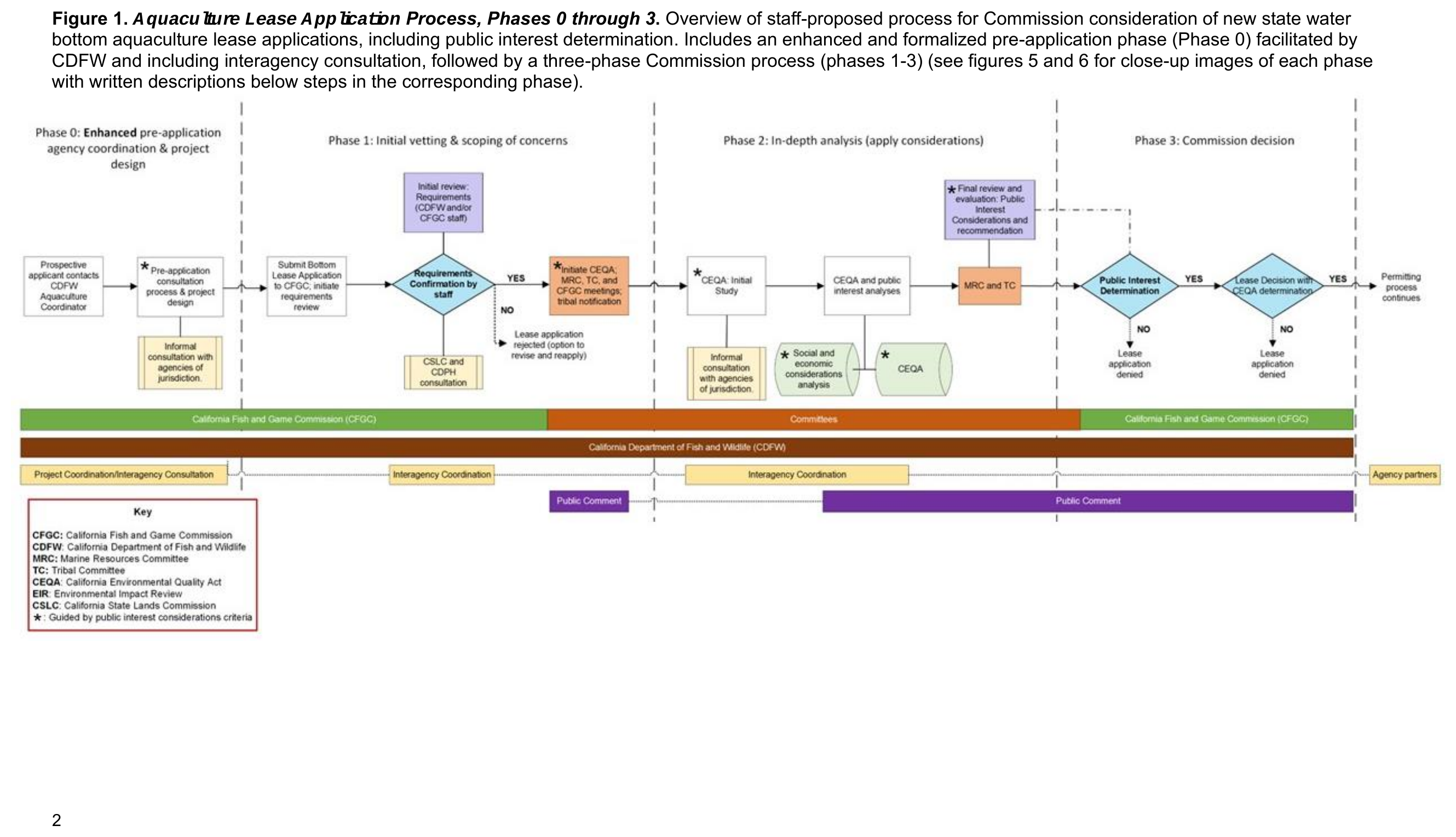
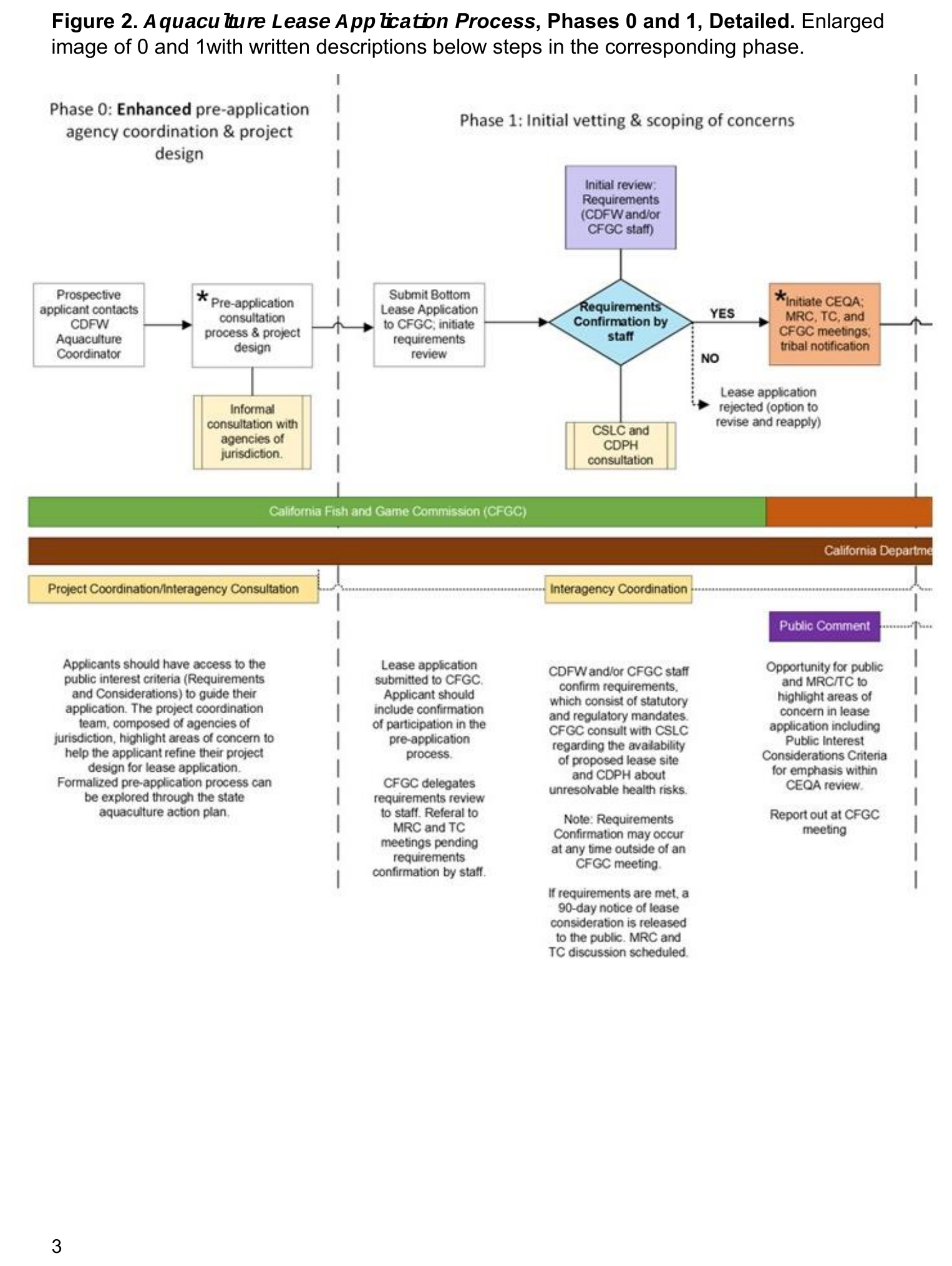
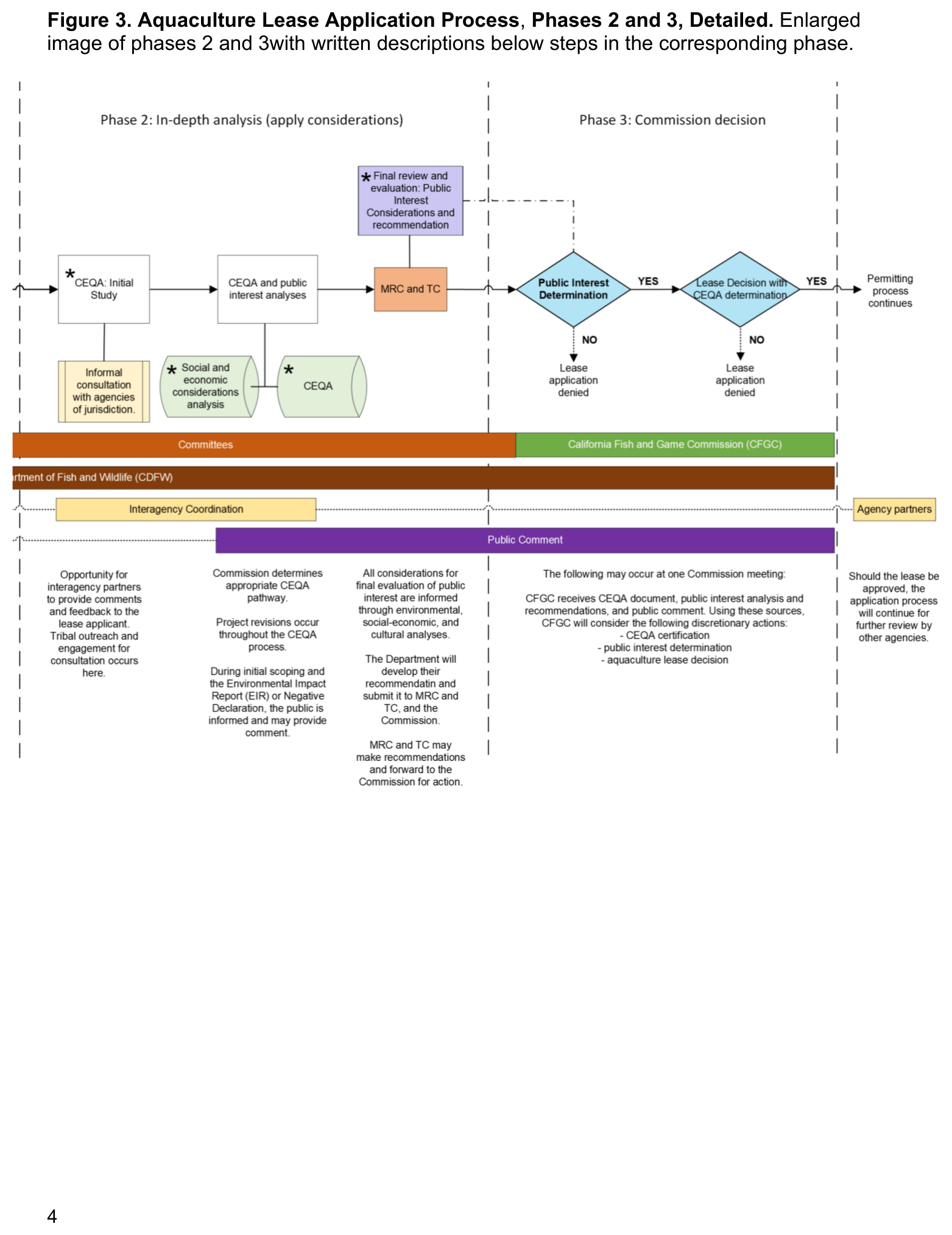
Figures reproduced from the CFGC-approved process document (8/23/2023). Tagged real-data.
Humboldt Bay shows the model works.
The Humboldt Bay Harbor, Recreation & Conservation District (HBHRCD) is the lead agency there. The District carried its own Mariculture Pre-Permitting EIR (SCH #2017032068, certified 2018; intertidal expansion certified 2023) through CEQA, the Coastal Commission, USACE, and the Regional Board on behalf of the whole footprint — and now issues tideland leases directly to qualified growers inside that already-permitted envelope. New entrants step into a pre-cleared program instead of running the full chain alone. San Diego Bay has limited equivalent paths. The rest of California's coast does not have one yet.
This is the proof of concept for the whole effort: one agency doing the heavy review once, so twenty farms don't each repeat it. Inside the working desk, the permit wizard surfaces these pre-permitted footprints automatically when you pick a location.
Pre-permitted lease vs. solo new lease
- Timeline
- 3–9 mo
- 60–120 mo
- Up-front cost
- < $10K
- $150K–$500K+
- Project-level EIR
- Usually no
- Yes, almost always
- Risk for small farm
- Survivable
- Rarely survivable
Federal context
NOAA's Aquaculture Opportunity Areas.
NOAA's programmatic work produced Atlas and AOA identification reports for the Southern California Bight — the closest thing the U.S. has to a pre-screened siting layer. Useful precedent, imperfect fit. We surface it so growers and agencies can see what already exists federally before California writes its own.
Read our full analysis of the NOAA precedent →| Process | NOAA WCR Final PEIS · signed 9/10/2025 by NMFS West Coast RA | Real data |
| Selected alternative | Alternative 4b · all types of aquaculture · Santa Barbara Channel + Santa Monica Bay | Real data |
| Species framing | Federal scope is broader than California's shellfish- and seaweed-only policy | Real data |
| Tiered review for small farms | Programmatic, but no small-farm carve-out | Real data |
| 2026 California case | Ocean Rainforest CC-0003-21 · federal-consistency approval with phased safeguards · Corps authorization remained separate | Real data |
| What CA should adopt | Pre-screened siting atlas · shared baseline · transparent suitability | Proposed |
| What CA should add | Shellfish and seaweed scope · small-farm tier · Tribal co-stewardship | Proposed |
Sources: NOAA Southern California AOA record; California Coastal Commission consistency certification CC-0003-21, cited by item number at the Coastal Commission. The Commission action was not a coastal development permit, state lease, or final construction authorization.
Where the chart actually stands
Soundings taken so far.
We won't paper over how early this is. Every counter below is current, and it moves as the work does — tap one to see the work behind it.
Keep going
Where this connects.
The tracker is the map of the current path. The rest of the chart says what it takes to actually operate — and what we're working to change.
Request a working seatThe whole passage
Permitting is one reef. See all ten stages from idea to buyer.
Open →Known gaps
Where the soundings stop — the rules and evidence still missing.
Open →Barriers & proposed fixes
What we'd change, why, and the precedent behind each proposal.
Open →Source documents
The underlying agency documents, mirrored and cited.
Open →